Young Minds, New Ideas
As I look at the changing food landscape in India, I see tremendous opportunities ahead. Growing health awareness, evolving consumer preferences, sustainability concerns, and rising entrepreneurship are reshaping the way we produce, market, and consume food. Across the country, startups are developing innovative solutions that address real needs while building sustainable businesses.
At the same time, I have learned that innovation cannot thrive in isolation. Young entrepreneurs need mentorship, infrastructure, market linkages, and a supportive policy environment to turn promising ideas into meaningful impact.
Having worked closely with entrepreneurs and innovators over the years, I am convinced that the future of India's food system will be shaped by young minds that can combine local knowledge and traditional wisdom with modern innovation and entrepreneurial thinking.
The Biggest Gaps in India’s Food Innovation Ecosystem

Pic 1: Crooked carrots prove that imperfect produce is just as nutritious as perfectly shaped vegetables. Choosing them helps reduce unnecessary food waste caused by cosmetic standards.
From my experience, while India has immense talent and creativity, food and nutrition startups - especially in regions like Uttarakhand still face major challenges in scaling their ideas . Limited access to funding, market linkages, infrastructure, and reliable information often prevents promising ventures from moving beyond the early stage. Although the food processing sector is a major employer in India supporting nearly 2 million workers in the registered sector and over 5 million in the unregistered sector.iv
In my interactions with startups and young innovators, I have seen that many founders struggle to navigate funding opportunities, regulatory requirements, and investor expectations. Infrastructure gaps in hilly regions like Uttarakhand further limit market access, it is difficult to connect producers to larger markets due to weak last-mile connectivity while branding and consumer trust remain key challenges in a competitive market.
Addressing these gaps will require more than financial support - stronger mentorship, better information access, improved infrastructure, and a supportive ecosystem are essential to help innovative ideas grow into sustainable businesses.
Why Youth-Led Innovation Is Critical Today
What gives me the greatest confidence about the future of India's food system is the growing role that young people are beginning to play - not only as innovators and entrepreneurs, but also as consumers who influence trends and around health, sustainability, and transparency.
India’s startup ecosystem has grown rapidly, especially after the launch of the Startup India initiativev in 2016, which has supported the rise of thousands of startups. The country has witnessed the emergence of more than 2.23 lakh recognized startups, creating over 23 lakh direct jobsvi. This growth has created a strong base for young innovators in food, nutrition, and sustainability.
From my perspective, one of the most encouraging trends today is the growing demand among young consumers for healthier, clean label, locally sourced, and more sustainable food choices. This shift is creating opportunities for businesses that generate both commercial value and positive social impact. Initiatives such as the Eat Right Youth Hackathon Uttarakhand 2026 play an important role by giving young innovators a platform to explore new ideas in food, nutrition, and sustainable entrepreneurship. They help nurture a new generation of food leaders who can combine local knowledge, indigenous ingredients, and modern innovation to build practical and sustainable solutions.
What Makes Some Food Startups Successful?

Pic 2: Successful startups are built on collaboration, customer understanding, financial discipline, and a clear long-term vision.
Over the years, I have seen that the most successful startups are often those that stay focused on solving real problems through simple, authentic, and purpose-driven solutions. Successful entrepreneurs understand their customers, know their business fundamentals, and maintain a clear long-term vision. This clarity helps them make better decisions and navigate challenges as they grow.
One of the most important lessons for startups, in my opinion, is the need to maintain financial discipline in the early stages. When unnecessary expenses are controlled, it allows businesses to invest more effectively in product development, customer acquisition, and growth.
This reminds me of Blu Mobilityvii, which initially stood out as a premium EV cab service provider, giving tough competition to its competitors. As the company expanded and went in to growth phase, an alleged diversion of funds (financial discipline) which was meant for further growth and expansion to buy more EV cars, was diverted to personal expenses.
For me, the lesson is clear: when startups grow and expand, they need to focus on the business needs and not lose their financial discipline with free flow of incoming money. The most successful ventures stay focused on solving a real problem, maintain discipline in spending, and grow around a clear and consistent value proposition.
The Role of Mentorship and Incubation Platforms
From my experience, mentorship is one of the most important drivers of entrepreneurial success. For young innovators, guidance on areas such as funding, regulations, market access, branding, and scaling can help transform promising ideas into sustainable businesses. Equally important are incubation platforms, which connect entrepreneurs with investors, institutions, and industry networks, creating the support systems needed for long-term growth.
The MSME sector contributes approximately 31% of the country’s GDP, nearly 49% of exports, and provides employment to more than 328 million peopleviii. These numbers underscore the importance of entrepreneurship as a driver of economic growth, with every business-including food startups-contributing to a larger national value chain.
When strong mentorship, incubation, and support systems come together, they help founders move beyond small-scale operations and build businesses that can grow, scale, and create lasting impact.
Emerging Trends Youth Innovators Must Focus On
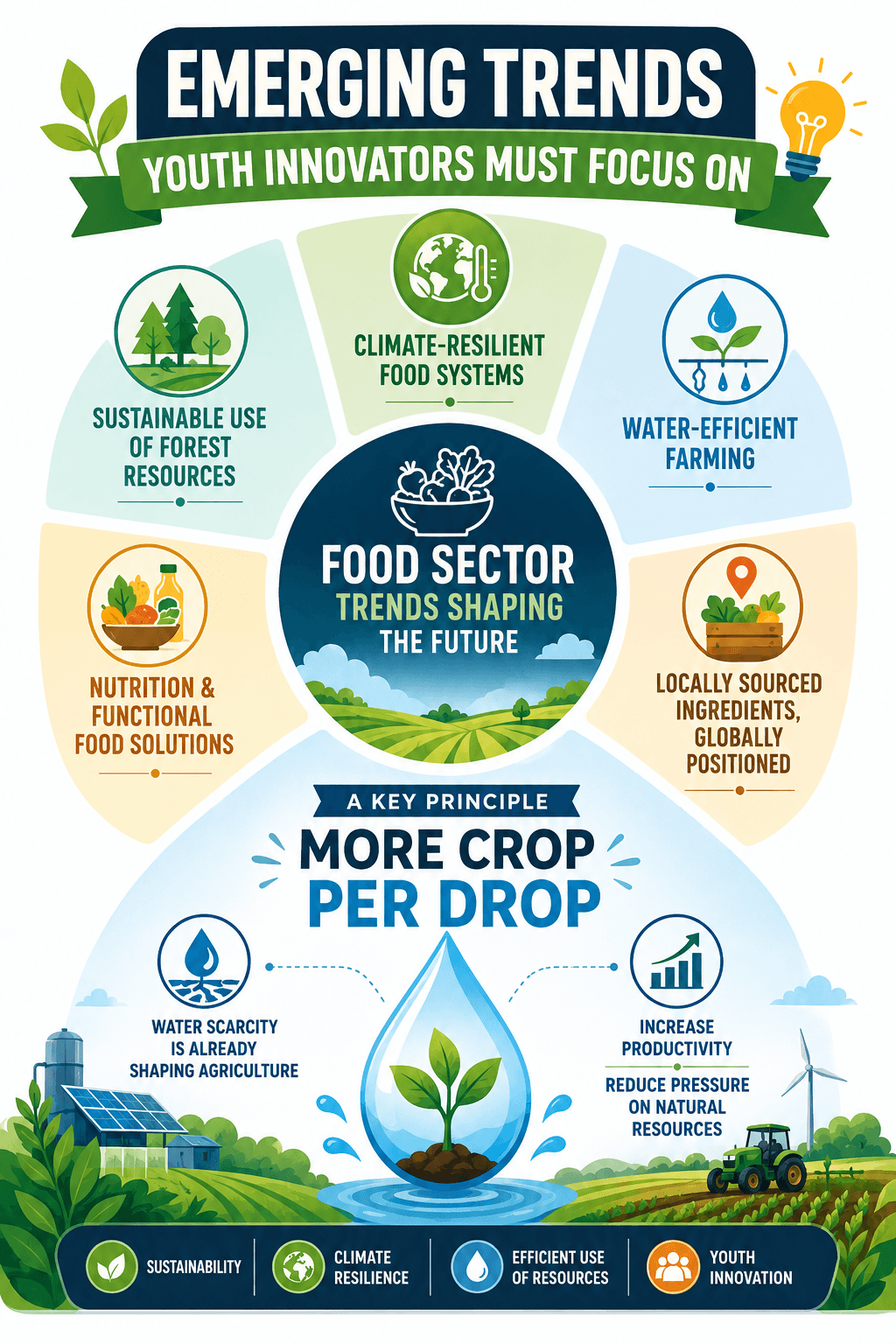
Pic 3: The future of food depends on producing more while conserving precious natural resources.
Looking ahead, I believe the future of food innovation will be shaped by solutions that balance sustainability, nutrition, and resource efficiency. Young entrepreneurs have an opportunity to focus on areas such as climate-resilient agriculture, water-efficient farming, nutrition-focused products, clean label products with minimal and locally sourced ingredients with wider market potential. One principle that continues to resonate with me is “more crop per drop” - producing more while using fewer resources. Ultimately, success in the food sector will not be measured by scale alone, but by the ability to build food systems that are resilient, sustainable, and fit for the future.
Turning Ideas into Scalable Solutions
For youth participating in innovation programs like the Eat Right Youth Hackathon, one lesson stands out to me: the market must come before the product. The most successful entrepreneurs rarely start with perfection-they start by understanding the core problem, testing simple solutions, identifying target audience and learning from users and their feedback.
One example I would like to share here: One startup identified a gap in pressure cookers available in the market - most products were designed for American-style cooking and did not suit Indian households. Instead of scaling immediately, they launched just 200 units as a pilot before scaling. User feedback helped refine the product and improve its market fit.
The more successful young entrepreneurs I’ve observed rarely start with perfection. Instead, they start with experimentation. They build, test, learn, and adjust - reshaping their ideas entirely based on what the market is actually telling them.
I also believe young innovators should build on local strengths but at the same time think globally as well. During the Eat Right Youth Hackathon, I came across a team that used solar dehydration to preserve seasonal Himalayan fruits and create a healthy “Himalayan Berry Mix,” showcasing how local resources can be transformed into sustainable food solutions. From my perspective, the greatest opportunity for young innovators lies in combining market understanding with local resources to build solutions that are both relevant and resilient.
Inspiring Examples of Youth-Led Innovation
Several youth-led initiatives across India demonstrate how local innovation can create meaningful social and nutritional impact.
One example is Kirti Kumar’s “Millet Laddoo” initiative, which partnered with women Self-Help Groups and government programs to promote millet-based nutrition products across multiple states. It showed how traditional grains can be reintroduced through simple, scalable innovation
Another example is Nirvana Organic, which transformed locally sourced fruits into value-added products. By replacing refined sugar with forest honey, the venture aligned with growing demand for healthier, clean-label foods and improved its market acceptance.
These examples highlight how local resources, when combined with consumer insight and innovation, can create sustainable and impactful businesses.
The Road Ahead
India’s food innovation future depends on empowering youth with the right skills, mentorship and opportunities. Beyond building businesses, they are strengthening local economies, improving nutrition, providing clean label products and creating sustainable solutions.
The path ahead lies in building supportive ecosystems where innovation is accessible, mentorship is strong, and local resources can be turned into scalable opportunities. By combining traditional wisdom with entrepreneurial thinking, India has the potential to become a global leader in sustainable food systems and nutrition innovation.
- Proxy Ideas Private Limited is a turnkey solutions firm specializing in food processing, nutrition, and food system innovations. The company works across industry, development, and policy domains to support sustainable, scalable, and impact-driven solutions in the food sector.
- FSSAI is the national regulatory body responsible for ensuring food safety, setting food quality standards, and regulating food businesses in India.
- The Access to Nutrition Initiative (ATNI) is a leading global benchmark organization that evaluates how major food and beverage companies contribute to nutrition and healthier diets
- Report from India Brand Equity Foundation
- The Startup India initiative is a Government of India program launched in 2016 to promote entrepreneurship by supporting startups through funding access, tax benefits, easier compliance, and incubation support. It aims to build a strong startup ecosystem, encourage innovation, and create jobs across the country.
- Startup India statistics Startup data
- Blu Mobility, an EV-based mobility startup or fleet service positioned around practical, commercial electric cab operations
- MSME Annual report from Govt of India MSME Report