Abhiir Bhalla is a dedicated youth environmentalist and sustainability consultant based in New Delhi. He serves on the board of the UK-based charity Commonwealth Human Ecology Council and was recognised by BBC World News in 2020 as one of the promising young voices in environmental advocacy. To date, he has had the privilege of leading over 250 workshops and speaking engagements at institutions such as the World Bank, the UK House of Lords and IIT Delhi. In acknowledgment of his efforts, the Government of India honoured him as a Youth Climate Champion.
Young people in India frequently encounter significant barriers in securing the attention of authorities and decision-makers. Globally, there are about 1.8 billion individuals aged between 10 and 24, making it the largest generation of youth in history. Approximately 90% of this demographic resides in developing countries. Often sidelined and not taken seriously due to misconceptions that equate youthfulness with inexperience, they struggle to meaningfully participate in crucial dialogues about national and global challenges. Despite these hurdles, their inclusion is essential, particularly in pressing issues such as climate change and improving food systems and nutrition, areas where fresh perspectives and bold innovations from young minds are not only valuable but necessary, as they are the ones who will inherit and shape the future of our planet.
As a child, Abhiir Bhalla didn't fully grasp the implications of climate change and its severe impacts—often dismissing it as peripheral to his immediate areas of interest. However, as he grew the real-world experiences began to shift his perspective. He slowly came to realize how air pollution was directly affecting not just his own health but also the well-being of his friends and loved ones.
"A newfound awareness sparked his curiosity about environmental issues and inspired him to join his school’s Environment Club. He quickly became an active voice in the movement, often leading campaigns against the use of polluting firecrackers. His involvement deepened with his role in championing the air pollution advocacy campaign agenda —an experience that not only broadened his understanding of environmental challenges but also equipped him with practical skills to advocate for cleaner air and healthier communities."
Young people are often excluded from major decision-making processes despite bearing the brunt of global challenges. In this interview, Abhishri Agarwal, Consultant at Nutrition Connect speaks to youth climate advocate Abhiir Bhalla on the role of heirloom crops in climate resilience, the need for policy reform, and the power of youth-led food systems transformation.

Abhiir representing Indian & commonwealth youth at COP-28 in Dubai
Abhishri: How does growing heirloom crops contribute to sustainability and climate resilience compared to conventional farming?
Abhiir: Heirloom crops are genetically diverse, regionally adapted, and often require fewer synthetic inputs compared to high-yielding monocultures. In India, traditional rice varieties like Kullakar (Tamil Nadu), Chakhao Amubi (Manipur black rice), and Navara (Kerala) have evolved over centuries to thrive in specific agroclimatic zones. These varieties are more resistant to droughts, floods, and pests—making them more climate-resilient. I’ve seen the success of such crops first-hand. My colleagues and I visited Bahraich, an aspirational district in northeastern Uttar Pradesh that floods every year, resulting in significant damage to life, property, and livelihoods. My colleague’s project has trained local farmers in riverbed cultivation of parwal (pointed gourd), which is rich in fiber, and vitamins and minerals like Vitamin A, B, C and calcium, iron, potassium. As a native crop, it is significantly more flood-resilient and has proven to be a great source of income for local farmers and nourishment for Uttar Pradesh and the neighbouring states.
A 2019 study by the Indian Council of Agricultural Research (ICAR) found that traditional rice varieties can withstand water stress better, with yields remaining stable even during erratic monsoons—critical in the era of climate change.
Abhishri - According to you, what does this imply in policy terms? What policy interventions are needed to make heirloom foods a viable solution for both nutrition security and environmental sustainability?
Abhiir - I believe the Government has, over the past three to four years, taken significant steps to promote heirloom foods—but there’s still plenty more that can be done. Here are three scalable interventions:
- Farmer-Led Seed Conservation and Distribution
Heirloom seeds are vanishing under the dominance of commercial hybrids. Supporting community seed banks and farmer networks is one of the most powerful ways to conserve traditional varieties. For example, the Navdanya Biodiversity Farm, led by Dr. Vandana Shiva, has preserved over 1,500 heirloom rice varieties and collaborates with farmers across 22 states to promote seed sovereignty and biodiversity. These seed banks reduce dependency on large seed corporations and safeguard climate-resilient, nutrient-rich crops. - Redirecting Agricultural Subsidies
India’s current subsidy structure overwhelmingly favors chemical fertilizers and water-intensive crops like paddy and sugarcane. A portion of the country’s $20 billion fertilizer subsidies should be reallocated to incentivize low-input heirloom farming—especially natural or organic methods that bolster both resilience and nutrition. Nutrition note: By promoting nutrient-dense traditional varieties, this shift would help address micronutrient deficiencies—particularly iron and zinc—in vulnerable populations. - Inclusion in Government Nutrition Programs
Integrating heirloom crops into large-scale feeding schemes can boost both nutrition outcomes and farmer incomes. When India declared 2023 the International Year of Millets, millets such as ragi, bajra, and jowar were added to the Mid-Day Meal Scheme and the Public Distribution System (PDS), improving dietary diversity and creating new markets for smallholder millet growers. A similar push to include heirloom rice (e.g., Kullakar, Chakhao Amubi), pulses (Desi moong, regional rajma), and oilseeds in these programs would further advance both nutrition security and climate goals.
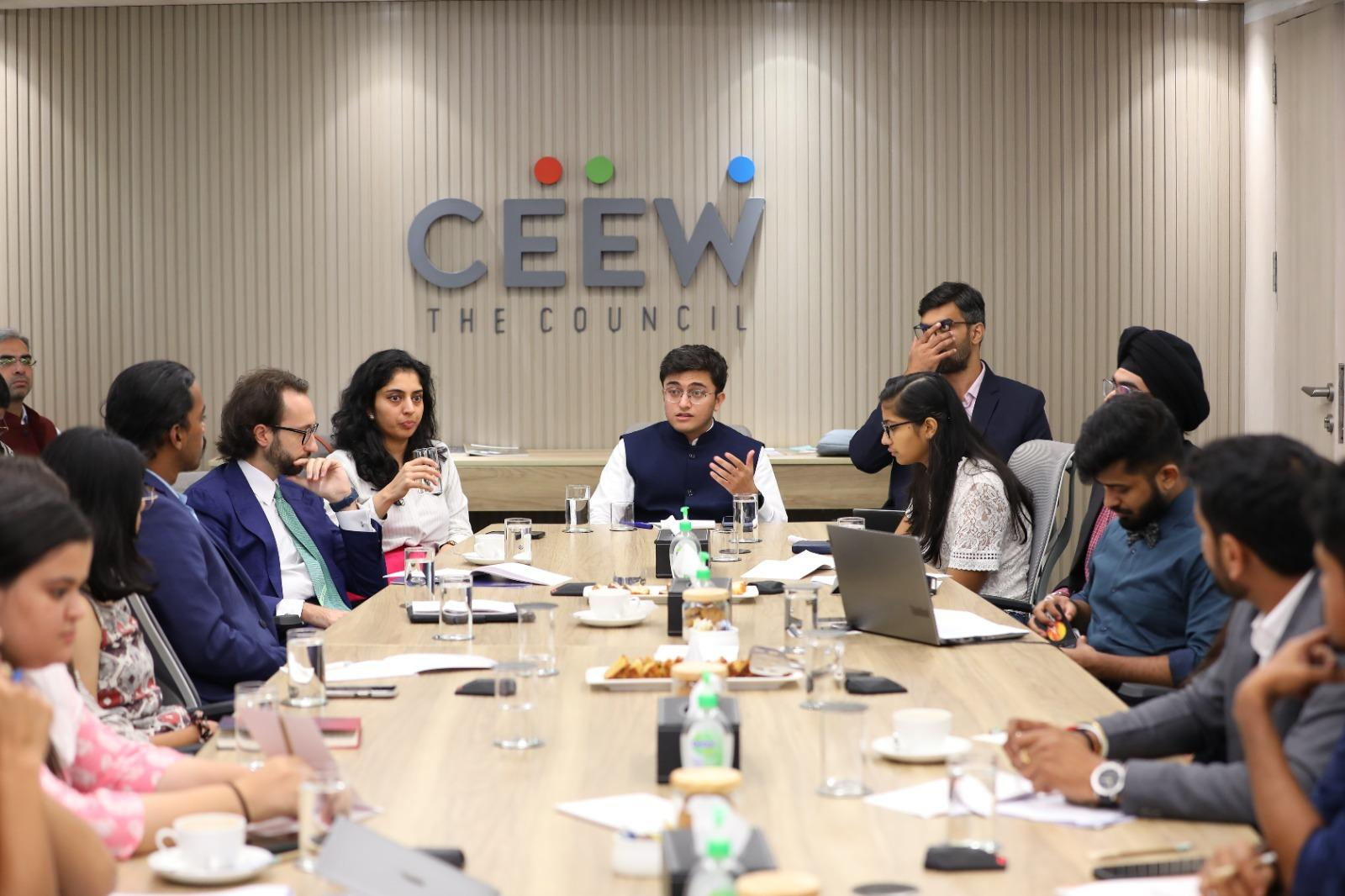
Abhiir participating at the Youth and Climate Convening organised by the Italian Embassy & CEEW
Each of these policies strengthens food sovereignty, enhances environmental sustainability, and ensures that nutrient-rich, climate-adapted crops benefit both farmers and consumers.
Abhishri – So my next question leads naturally … How can urban policies influence consumer access to heirloom and nutrient-rich foods in cities?
Abhiir – Great question—and a critical one. Urban policies have immense potential to reshape how cities like Delhi, Mumbai, Bengaluru, and the others produce, access, and consume heirloom and nutrient-rich foods, especially in a rapidly urbanizing country like India. We’re increasingly seeing a massive urban shift, with several villages becoming ‘ghost villages’ as younger populations move to urban areas in search of jobs.
Some great initiatives, if you ask me, can be driven by urban local governments. I’ve been seeing an uptick in urban farmers’ markets and residents’ welfare associations organizing theme-specific bazaars around veganism and plant-based meats. With the right push, there could be a niche created for “Heirloom Food Bazaars.” Mobile markets and last-mile delivery solutions can make such food available in underserved urban areas.
Additionally, public awareness campaigns through city schools and hospitals on traditional foods and health can build demand. For instance, the Odisha Millet Mission—launched in 2016—successfully introduced millets like ragi into over 1,200 urban schools and 50 hospitals, serving approximately 200,000 meals weekly and boosting both consumption and farmer incomes. State governments can encourage municipal corporations to adopt similar models for other heirloom foods like Navara rice, Desi moong, or indigenous leafy greens.
Heirloom products could be incorporated early into the diets of growing children and adolescents through school feeding programs and Anganwadi (Integrated Child Development Services) schemes. These could be driven by community-supported agriculture and farm-to-fork models. State and national governments can offer incentives to retailers, cafes, and cloud kitchens that feature traditional foods—creating aspirational demand. Tax rebates, for instance, or certifications like “Responsible Kitchen” for outlets promoting heirloom menus could encourage partnerships between urban foodpreneurs and rural Farmer Producer Organizations (FPOs) to bring traditional ingredients into modern, convenient formats.
Abhishri – How can public-private collaborations accelerate the shift toward sustainable food systems while ensuring the preservation of heirloom foods?
Abhiir – Government policy alone is not enough to pivot the country’s journey toward sustainable food systems. Strategic collaborations between the public sector, private enterprises, social entrepreneurs, and farming communities can unlock scale, innovation, and inclusivity—while preserving the rich biodiversity of heirloom crops and improving nutrition and resilience.
Public–private partnerships (PPPs) can bridge the gap between heirloom crop growers (often smallholder farmers) and urban consumers by integrating traditional produce into mainstream retail and digital commerce platforms. For instance, platforms like BigBasket and Amazon India now feature “Organic & Millet” sections, often stocked by farmer cooperatives supported by the Small Farmers’ Agribusiness Consortium (SFAC).
Additionally, co-branding and value-added product development can marry traditional knowledge with modern packaging, nutrition science, and design. Government-supported FPOs or cooperatives can co-create branded heirloom products with private food companies—examples include ITC’s Aashirvaad Millet Flour, Tata Soulfull Millet Muesli, Slurrp Farm Millet & Grain Bars, and Adya Organics’ Heritage Grain Mix.
Private-sector CSR (Corporate Social Responsibility) funds can also be channeled toward seed conservation programs with local communities and seed banks. Training workshops on climate-resilient agroecology provide another avenue for promoting soil-health regeneration through natural-farming methods with traditional crops. For example, the JSW Foundation supports agrobiodiversity programs in tribal regions of Maharashtra and Karnataka, helping preserve rare seeds and traditional cropping patterns.

Speaking on climate policy negotiations following COP27 & ahead of the G20 at an ISHRAE's Green Conclave in Pune
Abhishri - How can young advocates and organisations push for stronger sustainability policies related to food and agriculture?
Abhiir - The demographic dividend that the country depends on to build a resilient and thriving future. Today, young people are stepping beyond the role of passive observers and emerging as dynamic researchers, activists, entrepreneurs, and policy influencers—actively shaping solutions to the pressing challenges of climate change and agriculture.
To achieve lasting, systemic change, young people must be engaged throughout the entire policy pipeline—from raising awareness and advocating for change to shaping implementation and ensuring accountability through monitoring. Shifting public discourse is raising consumer awareness and slowly building a ‘bottom-up’ momentum for policymakers to support and usher systemic change, in favour of heritage foods.
More is needed however — Students and youth organisations can intensify their collaboration with chefs, nutritionists, and historians to produce heirloom recipe books, video documentaries, and podcasts. Students can leverage purposeful internship opportunities to provide a lens on these matters – contributing to drafting policy briefs, preparing white papers, and conducting field assessments on heirloom farming and agroecology.
Young people have leveraged digital campaigns to successfully amplify marginalised voices, revealing gaps in policy that need action, and demanding stronger accountability and transparency in sustainability efforts, particularly in addressing and eliminating greenwashing. These campaigns can be taken a step further still; to catalyse change in education systems, calling for an inclusion of ‘food systems literacy’ in school curricula and extracurricular programs.
I’ve heard that the US-based Edible Schoolyard Project has inspired Indian versions like school kitchen gardens in states of Kerala and Sikkim in India, which are now also teaching lessons on biodiversity and sustainability to their students.
As advocates for change, we must demand a seat at the table where crucial food and climate decisions are being made—decisions that will most directly impact us, the youth. Through platforms like YOUNGO (the UNFCCC’s youth constituency), my fellow Indian delegates for instance, have been steadfast advocates for agroecology, strengthening indigenous food systems, and promoting sustainable diets in global negotiations. But the work doesn’t stop there. Young change makers can begin today, right in their own communities. By forming state-level food policy groups or city-based food justice coalitions, we can push for local policy changes that promote more sustainable and equitable food systems. The future of our countries and the world over, is shaped by the voices and actions of the youth today.